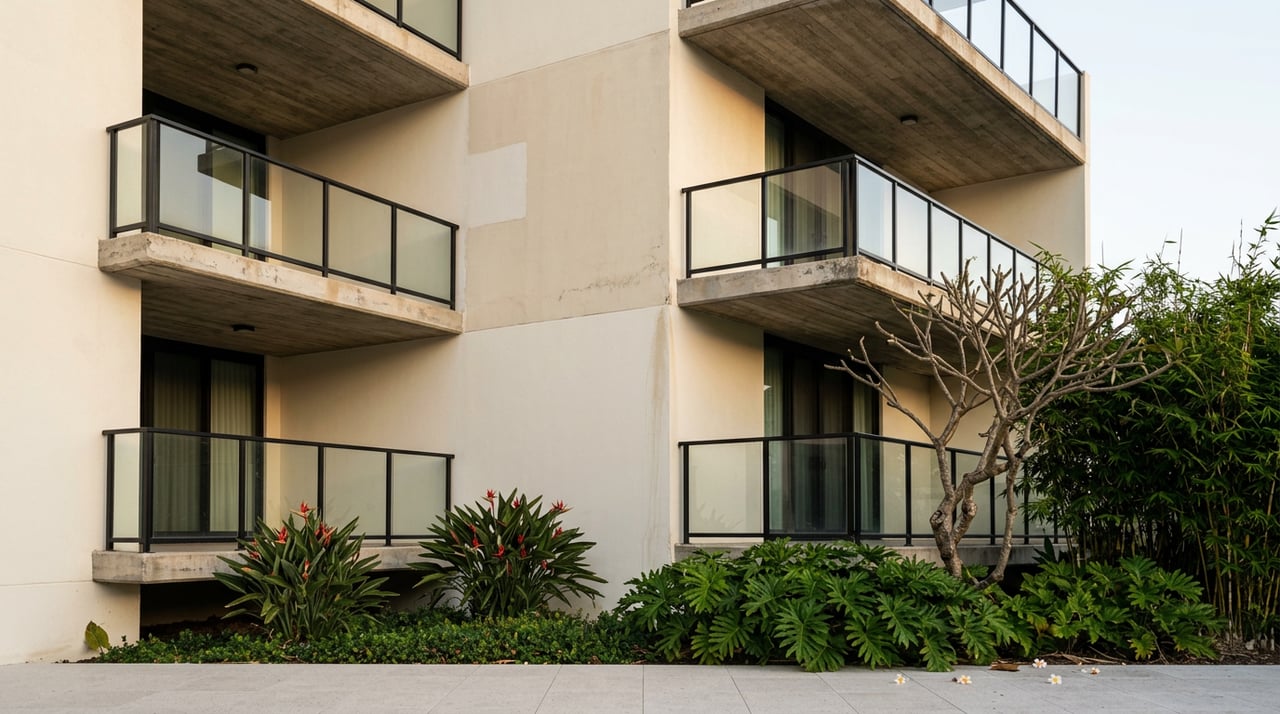
In much of the world, a buyer can treat wastewater as a utility that runs under the street and gets billed by the city. Jacó has never worked that way. In September 2023, Garabito's then-mayor told CRHoy that the canton had no wastewater treatment at all. The Sala Constitucional's 2024 resolution likewise records that Jacó lacks a treatment plant and a sanitary sewer. As a result, every condominium, hotel and house in town handles its own wastewater, through its own system, on its own budget.
That puts a part of the building you are buying where the listing never mentions it. A Jacó condo with its own treatment plant can come with a lab-testing and reporting obligation to the Ministerio de Salud. The public sewer that would replace that plant has been promised, financed, defunded and court-ordered over two decades. In the government's results report for 2025, the latest version of that sewer still showed zero physical progress.
What the Ministerio de Salud asks of a building that treats its own water
The most concrete friction appears in the operational reporting rules. The Ministerio de Salud's guidance on wastewater says any generator has to file operational reports if it discharges wastewater to a natural receiving body such as a river or stream, discharges to a sanitary sewer, or reuses wastewater for any purpose.
Each report is generated only through the ministry's SIRROAR platform. A digital submission to the local Área Rectora de Salud has to include:
- Digital signatures from the property's legal representative or owner and from the technical lead
- Laboratory results covering physical, chemical and microbiological analysis, signed by the responsible professional
- A digital endorsement, or refrendo, from the Colegio de Químicos de Costa Rica
The same page lists two automatic exemptions. Single-family homes are exempt. So are generators that discharge only ordinary wastewater into a sanitary sewer and appear in the regulation's Annex 1. Other generators can request an exemption under Annex 3, and the health authority has up to 10 business days to rule on the request.
In Jacó, the sewer-based exemption has nothing to attach to, because there is no sewer to discharge into. A multifamily building whose treated water goes to a stream or is reused falls within the reporting categories the ministry lists, unless it has obtained an exemption. Where that applies, the lab work, signatures and endorsements become a recurring operating item. Who files and who pays in a given condominium is a question for the building's documents and for Costa Rican counsel. A detached house on its own lot falls in the category the ministry lists as exempt. That gap is a real difference between a Jacó condo and a Jacó house, and it never appears in a price per square meter.
Where the treated water is allowed to go
How a building gets rid of its treated effluent matters as much as the plant that treats it. Executive Decree 39887-S-MINAE governs treatment systems for wastewater that is discharged or reused anywhere in Costa Rica. Where no working sanitary sewer exists, it allows four routes, alone or combined:
- Discharge to a receiving body of water, with MINAE authorization
- Reuse
- Infiltration into the soil, based on a professional's calculation
- Evaporation, also based on calculation
The decree also requires a Ministry of Health location permit before construction plans for a treatment system can be reviewed. The official text records an amendment by Decree 44790, dated August 29, 2024.
For a Jacó buyer, the route on file shapes the building's paperwork. Discharge to a stream brings a MINAE authorization into the picture, and discharge to a stream or reuse falls within the health ministry's reporting categories. Two buildings on the same street can carry quite different compliance files.
This is general information about the public rules, not legal, tax or financial advice. A Costa Rican attorney and the building's technical lead can confirm how these rules apply to a specific property.
Twenty years of the same promise
The private systems would matter less if a public sewer were close. The record shows why nobody should model that.
| Year | What happened | Status afterward |
|---|---|---|
| 2005 | Garabito handed its municipal aqueduct to AyA, with AyA committing to build Jacó's sewer within five years, according to CRHoy | The 2010 sewer was never built |
| 2019 | A KfW loan approved through Ley 9723 financed sanitation for Jacó, Quepos, Golfito and Palmares | Jacó was added only after long negotiations |
| 2023 | Hacienda withdrew from the KfW loan contract, citing zero use of loan funds as of December 31, 2022 | The program lost its financing |
| August 1, 2024 | The Sala Constitucional ordered AyA and the Municipalidad de Garabito to budget for and build a treatment plant and sewer | Construction capped at two years |
| February 25, 2025 | BCIE approved a US$565 million loan for five AyA sanitation projects, including Jacó | Still awaiting formalization at the end of 2025 |
Semanario Universidad reported that the court gave the institutions 18 months to budget and coordinate the works, and set a completion limit that "no podrá exceder los dos años." The case grew out of an amparo filed by environmental attorney Álvaro Sagot. The two-year window counted from August 1, 2024, so it closed on August 1, 2026.
After the KfW financing collapsed, then-mayor Tobías Murillo told CRHoy that the municipality had been pressing AyA for years: "Son muchos años de espera y de que nos pongan mil excusas, pero nadie nos resuelve."
Where the replacement loan stood at the end of 2025
The BCIE approval gave the sewer a defined scope for the first time in years. According to Semanario Universidad's February 2025 report, the Jacó component covers 38 km of sewer line, 14 pumping stations and a treatment plant, at an estimated US$69 million. AyA said the loan still needed authorization from Hacienda, MIDEPLAN and the Banco Central before the work could be tendered.
The Programa de Saneamiento en Zonas Prioritarias, which now covers only Jacó and Golfito, had a 2025 goal of 22.5% physical progress, and the reported result was 0.00%. MIDEPLAN's 2026 results report says the new financing "no se había formalizado al cierre de 2025," and that AyA was updating internal documents while it waited for BCIE loan No. 2344 to be formalized.
The same report draws its own lesson. Setting physical-progress targets without secured financing, it says, hurt the program's results.
BCIE's project page lists the program at the "Approval" stage under line of credit 2344.
So the incentives line up in an unhelpful way. A buyer weighing a building's aging treatment plant might expect a public connection to make the plant obsolete. In the official record, though, the public option is a loan waiting for formalization, followed by a tender, followed by 38 km of construction. For a five- or ten-year hold, the building's own system is the system.
The water coming in runs on a separate clock
Drinking water follows its own project timeline, and it is easy to confuse with the sewer. AyA's "Mejoras y ampliación al sistema de acueducto de Jacó, Garabito, etapa II" is an aqueduct project, not a sanitation one. MIDEPLAN's planning sheet puts it at 15.31% cumulative progress as of December 2025, with execution at 0%, and schedules this stage to finish in 2028. The progress weights explain the gap. Construction counts for 75% of a project's total, so 15.31% means the work is still in the preparatory phases.
Back in 2019, AyA projected that the Jacó water component would be finished by the fourth quarter of 2023.
None of that changes the wastewater picture. It does show that Jacó's two big water projects have both moved slowly, and that the dates in planning documents tend to slip.
Questions to bring to the condo administrator and your attorney
These go in the due-diligence file next to the HOA budget:
- Which of the decree's routes does the building's treated water take, and what MINAE authorization covers a discharge to a receiving body?
- Does the building file operational reports through SIRROAR, or does it hold an exemption? If it files, can you see recent filings with signed lab results and the Colegio de Químicos refrendo?
- Who is responsible for the filings, which budget line pays for the lab analyses and technical oversight, and how has that line moved over recent years?
- When was the treatment system approved, and what permits support it?
- Is any money set aside for repairing or replacing the plant, given that the public sewer showed no physical progress at the end of 2025?
A house on its own lot raises a shorter version of the same questions, because the ministry lists single-family homes as exempt from operational reports.
Short answers
Will Jacó condos connect to a public sewer soon? MIDEPLAN reported 0.00% physical progress on the Jacó sanitation program for 2025, with its BCIE financing still not formalized at year-end.
Did the Sala IV order set a deadline? Yes. The August 1, 2024 resolution capped construction at two years, a window that ended August 1, 2026.
Do houses carry the same reporting obligation as condos? The Ministerio de Salud lists single-family homes as exempt from operational reports.
When you are comparing Jacó buildings, the wastewater file can tell you more than the lobby does. The advisors at Bluezone Realty International can help you request a building's treatment-system records and coordinate the review with legal partners. Schedule a private consultation.