Neighbors have proposed three fixes for the public strip along Playa Dominical: hand cleanups, barriers to keep vehicles off the sand, and a rebuilt children's playground. All three now have a formal answer. In June 2026, the Instituto Costarricense de Turismo (ICT) issued a legal opinion on each one, and each answer runs through the same office. Volunteers can clean the beach once the Municipalidad de Osa authorizes it. Barriers and a new playground have to be municipal projects, each with its own administrative file, and community groups can contribute to them but cannot run them.
That office is also under a constitutional court order to clear unauthorized commercial activity from the same stretch of beach. The deadline for that order passed in March. Whatever changes on the beachfront this high season will come out of one municipal department in Osa.
Playa Dominical answers to Osa
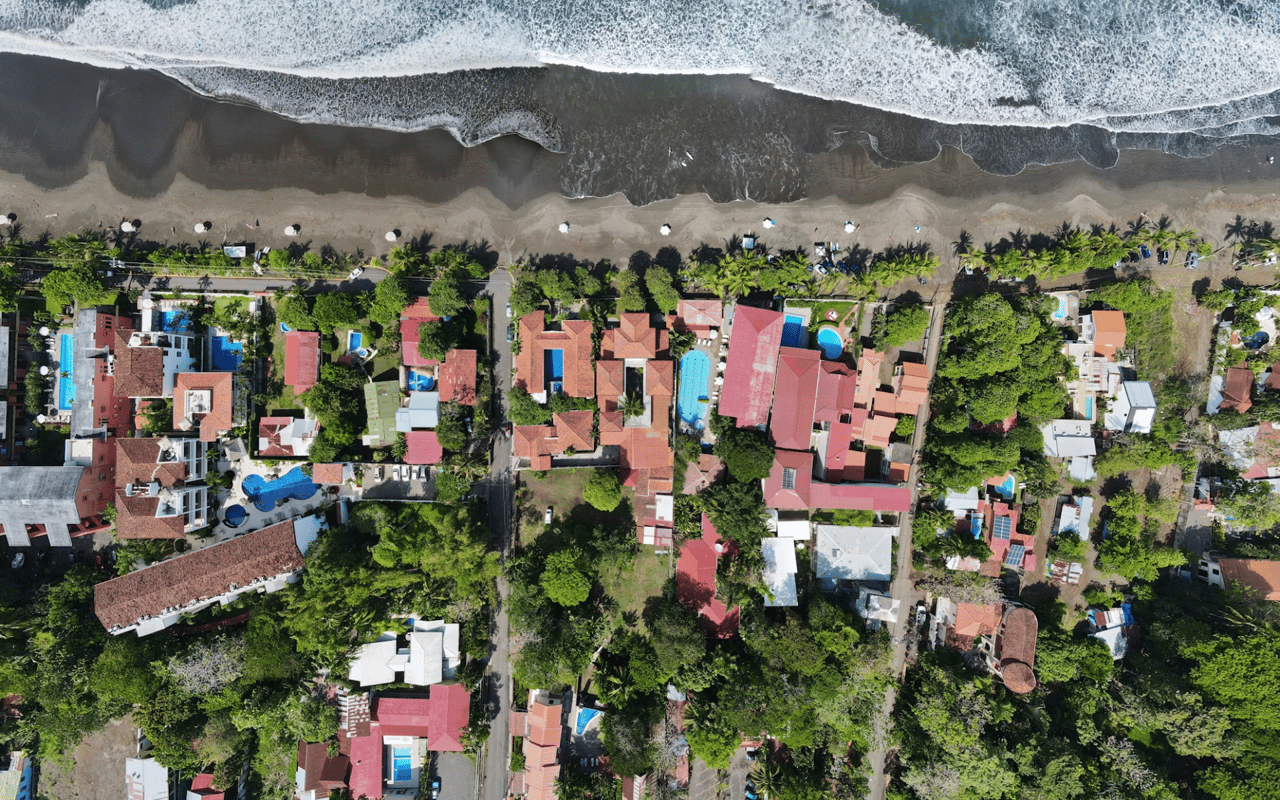
The beach sits in the canton of Osa. ICT lists the Matapalo-Barú coastal plan on the Quepos side under the canton of Quepos, in a separate record. Costa Rica's maritime-terrestrial zone, or ZMT, is a 200-meter strip measured inland along both coasts. The municipality runs it day to day, and ICT oversees it.
The part closest to the water is the public zone, and the rules for it are strict. In an ICT legal opinion dated May 28, 2026, the agency describes it as land for common use, free passage and the shared enjoyment of the beach. Activities can be allowed if they are temporary, leave passage open and involve no permanent construction. As Entre Cantones quotes it, Article 12 of Ley 6043, the 1977 maritime zone law, prohibits building, fencing or occupying the zone without legal authorization.
Courts have enforced these rules on this coastline before. In June 2023, according to La Nación, the Sala Primera upheld a ruling won by the Contraloría General de la República. That ruling annulled three concessions at Punta Dominical. It also ordered Osa, ICT and INVU to revise the Punta Dominical coastal plan so it leaves out wetlands, mangroves and other land classified as Patrimonio Natural del Estado.
A court deadline that ran out in March
The current case started with a petition from people in the community. The sequence, from the court record and regional press:
- August 29, 2025. Attorney Karl Villalobos Hoffmann files an amparo petition on behalf of Playa Dominical neighbors, case 25-026160-0007-CO.
- November 14, 2025. The Sala Constitucional issues judgment 2025-037551. It notes that Osa had carried out removals in the past, finds that the occupation kept coming back, and orders the municipality to inspect, act and report back within four months.
- March 14, 2026. The four-month deadline expires, as reported by Guananoticias.
- August 13 and 14, 2026. Municipal staff clear vendors from the zone, and the same outlet reports they were back the next day.
- Early September 2026. Entre Cantones reports that the Sala granted a disobedience motion. The motion orders the mayor and the acting head of Osa's ZMT department to comply with the November ruling.
- September 29, 2026. A follow-up report in Entre Cantones says unpermitted commercial activity was still on the public zone.
In early November, the court order will have been in force for close to a year. Osa's ZMT department is the office responsible for reporting back to the Sala. It is also the office that has to open the files for every community idea below.
What ICT told Osa about the neighbors' ideas
In May 2026, Osa asked ICT, under municipal reference PZM-0133-2026, how the community could help on the beach. ICT's planning division passed the question to its legal office. That office answered on May 28 and again, in more detail, on June 5 in opinion AL-A-0663-2026. The June conclusions read as a rulebook for the public zone:
| Proposal | What the June 5 opinion allows | Who carries it out |
|---|---|---|
| Community cleanups | Manual, temporary, low-impact work under supervision. A written authorization or a municipal volunteer program could be enough for single cleanup days. Any heavy machinery, vegetation removal, leveling or placing rocks is ruled out. | Volunteers, with municipal authorization |
| Rocks, bollards or barriers to stop vehicles | Can be considered only as a municipal public-order measure. It needs an administrative file, a technical justification and a formal written decision, and it must keep pedestrian passage, emergency access and evacuation routes open. | The municipality, coordinating with SINAC-ACOSA, CNE, MOPT, INVU or SETENA as needed |
| Replacing the deteriorated playground | Only as municipal public works for general use, placed where possible in a recreational area of the restricted zone under the coastal plan. It cannot be an occupation permit for a private association. | The municipality, with the Asociación de Desarrollo Integral free to donate or collaborate |
The opinion also sets limits on how residents can help. Any contribution from a community group cannot turn into private occupation, exclusive use, fencing, fees, a property right or a concession. The car barrier rule works the same way. Rocks can only go in as a municipal measure with a file and a stated reason, and a private group cannot place them.
The playground neighbors built around 2021
The playground is the clearest example of how this works. In October 2025, Entre Cantones reported on a neighbor-led effort to refurbish the playground in Playa Dominical's maritime zone. The site has benches, tables, hammocks, a slide, a wooden tunnel and a small tower, and it would be funded by donations from Costa Rican and foreign neighbors. One of the organizers, César Valverde, described the situation to the outlet:
"This place has existed for about four years, but over time it has naturally deteriorated. What we need now is the Municipality's permission to recondition the site, which would be available to children. It is a citizen initiative so that public property is available to the people."
Seven months later, ICT's answer went past permission. The opinion says the correct legal route is not to authorize a third party to occupy the public zone. Instead, Osa would treat the playground as a municipal project. It would open a file, confirm that the work fits the coastal plan, justify the public interest, obtain technical reviews on safety, accessibility, risk, environment and maintenance, and issue the decision approving it. The opinion also suggests placing it in the restricted zone, set back from the public strip, if the coastal plan includes recreational use there.
So the donations and volunteer work are still welcome. The project, however, now belongs to the municipality.
Why the tsunami routes come first
One condition appears in every answer. Dominical, Dominicalito and Barú together earned Tsunami Ready recognition from UNESCO's Intergovernmental Oceanographic Commission in November 2022. The preparedness work behind it included evacuation maps and signs marking routes, assembly points and tsunami hazard zones.
ICT names that recognition directly. Any physical measure, furniture or structure in the public zone has to be assessed for risk so it never blocks evacuation routes, emergency access or people's safety. Any barrier meant to keep trucks off the sand also has to leave clear passage for people walking and for emergency vehicles, and it has to protect the evacuation routes before the municipality can approve it.
Following the beachfront from here
A few reference numbers keep the details straight for anyone writing to the municipality, joining a cleanup or contributing to the playground:
- Sala Constitucional case 25-026160-0007-CO, judgment 2025-037551 of November 14, 2025, is the court order covering commercial activity on the public zone.
- Osa reference PZM-0133-2026 is the municipality's question to ICT about cleanups, barriers and the playground.
- ICT opinions AL-A-0625-2026 of May 28 and AL-A-0663-2026 of June 5, 2026 are the legal answers to that question.
- The Municipalidad de Osa's Departamento de Zona Marítimo Terrestre is the office that opens the file for any of it.
For one-day cleanups, ICT says a written authorization or a municipal volunteer program could be enough.
This post is general information about public rules, not legal advice. Anyone planning activity in the maritime zone should confirm the details with Osa or a Costa Rican attorney.
Living near Playa Dominical means living next to land the public owns and the municipality manages. If you would like to understand how the maritime zone rules affect a home or lot near the coast, Bluezone Realty International can walk you through it with the right legal partners. Schedule a private consultation.